What are the Health Benefits of Red Light Therapy?
By Liesl Bernard, CEO of Kalon Search
Picture your cells running low on batteries. They're working harder than they should to keep up with everyday wear and tear, inflammation, and the slow grind of aging. That's the problem red light therapy is designed to solve, and the science behind it is more compelling than the wellness-trend packaging might suggest.
Red light therapy—also called photo-biomodulation (PBM)—uses specific wavelengths of red (roughly 620–700 nm) and near-infrared (NIR, roughly 700–1100 nm) light to influence cellular function. Unlike UV light, these wavelengths don't damage DNA or cause burns when used at therapeutic doses. Instead, they are absorbed by cellular components and trigger biological responses that can reduce inflammation, support tissue repair, ease pain, and improve overall cellular energy production.
And this isn't fringe science anymore. Clinical studies, including reviews published in journals like the Journal of the American Academy of Dermatology, back up real benefits for skin health, wound healing, joint and muscle pain, and inflammatory conditions. The catch is that results aren't automatic—they depend on getting the details right: wavelength, dose (fluence in J/cm²), irradiance (power density in mW/cm²), treatment time, and how consistently you show up for it.
Mitochondria: The Cellular Powerhouses Red Light Activates
The story centers on mitochondria, the “powerhouse of the cell” phrase you probably remember from ninth-grade biology. These tiny organelles live in nearly every cell in your body and are responsible for producing Adenosine Triphosphate (ATP), the energy currency that powers essentially everything you do: moving, thinking, healing, even digesting.
Inside the mitochondrial electron transport chain, the enzyme cytochrome c oxidase (Complex IV) plays a central role. Red and near-infrared photons are absorbed by this enzyme. This absorption can:
- Free up the enzyme to work faster by knocking loose a molecule (nitric oxide) that's been slowing it down
- Speed up your cells' energy-production line, so they can generate power more efficiently
- Boost the cell's electrical charge, which is a key sign of healthy, high-functioning mitochondria
- Ramp up ATP output — literally more fuel for your body to run on
- Send a small, helpful stress signal (a brief uptick in reactive molecules) that tells your cells it's time to kick repair processes into gear
- Trigger a cascade of downstream benefits — less inflammation, better blood flow, and faster tissue repair
In stressed or injured cells (common in chronic inflammation, injury, or aging), mitochondria often underperform. Photo-biomodulation can help restore more efficient energy production, which is why benefits appear across such a wide range of conditions.
Which Red Light Device is Right for You?
Not all red light devices are created equal, and picking the right one just comes down to what you're trying to fix and how deep you need the light to go.
Single bulbs and small home fixtures
Think of these as your entry point—screw-in bulbs or small handheld units that are perfect if you've got one specific problem to target: your face, a nagging joint, a wound, a sore muscle. Because they put out less power, you'll need to sit with them longer (usually 15–30+ minutes) to get a meaningful dose.
The upside is they're cheap, simple, and low-commitment—a great way to dip your toes in or keep maintaining results once you've done more intensive treatment elsewhere. Just don't expect full-body or deep systemic benefits from these; they're built for spot-treatment, not whole-body wellness.
LED panels
This is where things get more serious. LED panels pack arrays of red (~660 nm) and near-infrared (~850 nm) light together and deliver it at much higher intensity — often 50–150+ mW/cm² — which means shorter sessions (8–20 minutes) can actually do more. Depending on the size, a panel can cover half your body or more in one go, making them a solid fit for skin goals, muscle recovery, general inflammation, or just overall wellness maintenance.
If you're shopping for one, look for panels that are upfront about their measured irradiance and EMF levels, and that combine both wavelengths—that combo is what lets you address surface-level and deeper tissue needs at the same time. For most people who want real, consistent results without going to a clinic, this is the sweet spot. Brands like Joovv provide medical-grade red light therapy devices.
Class IV laser therapy
This is the heavy machinery — professional-grade lasers pumping out high-power infrared light (800–1064+ nm) that can reach several centimeters, sometimes inches, into your tissue. That kind of depth is what makes it so effective for deep muscles, tendons, ligaments, and joints—places LED panels simply can't reach as effectively.
Sessions are quick, but the energy delivered per session is much higher. If you're dealing with an acute injury, a stubborn chronic pain issue, or recovering post-surgery, this is the level of treatment worth seeking out—but you'll need to go to a clinic, since these are classified as medical devices and aren't something you'll find for home use. Healios is a reliable option trusted by professional athletes.
The quick version:
- Single bulbs → cheap, targeted, surface-level fixes
- LED panels → your best all-around option for consistent home use
- Class IV lasers → the serious tool for serious, deep-tissue problems
How to Use Red Light Therapy: Distance, Time, and Frequency
Here's the thing about red light therapy: more isn't better. There's a sweet spot. Enough light to trigger a response in your cells, but not so much that you overdo it. Scientists call this the biphasic response (or Arndt-Schulz law), but really it just means that the dose matters.
Here's what that looks like in practice:
Distance
Keep the device 6–12 inches from your skin. Closer if you're targeting something deeper (a joint, a muscle); farther back if it's just your skin you're after.
Time
5–20 minutes per area, depending on your device and your goal. Skin usually needs less exposure. Joints and muscles usually need more.
Frequency
3–5 times a week covers most goals. Dealing with something acute or pushing hard for recovery? Daily sessions can help. But here's the real secret: showing up consistently beats the occasional marathon session every time.
Skin prep
Clean, bare skin lets more light through. That means no lotions or sunscreen blocking the way. And if you're using a stronger device, wear eye protection.
One more thing worth knowing: home devices are weaker than what you'd get in a clinic. So, if you're using one at home, you may need a bit more time or a bit more frequency to get into that “therapeutic” zone (roughly single-to-double-digit J/cm²).
Key Benefits of Red Light Therapy
Inflammation
Red light therapy can calm down the inflammatory response in your body. It's great for joint pain or inflamed skin—this is where evidence is strongest.
Healing faster
Cuts, wounds, strained muscles, tendon issues. Red light can speed up the repair process. The earlier you start after an injury (think hours to days), the more it seems to help.
Chronic pain
If you're dealing with something like osteoarthritis, nerve-related discomfort, or long-term musculoskeletal pain, there's real evidence this can help. Just don't expect overnight results. This is a slow-build benefit that rewards sticking with it.
A few bonus wins:
- Better skin—more collagen, fewer fine lines, smoother texture
- Support for hair regrowth if you're dealing with pattern thinning
- Easier recovery from certain cancer treatment side effects, like mouth sores or radiation-related skin irritation
- Researchers are also poking around at brain and metabolic health applications
Red Light Therapy: Home Use vs. Healing Center
At home, you're in the driver's seat. It's great for upkeep—think skin goals, mild inflammation, general recovery—and because you can use it daily without breaking the bank, consistency is easy. The tradeoff? Less power, and you have to stay disciplined about actually doing it right (distance, timing, etc.). If you're dealing with something deep or serious, home devices will get you there slower, if at all.
At a clinic, especially one running Class IV lasers, you're getting the heavy artillery. This is the move for acute injuries, stubborn joint or tendon pain, or anything that needs real depth and intensity. You'll likely need fewer visits to see progress, though each one costs more.
Honestly? A lot of people do both. Start at a clinic to tackle the immediate problem, then keep a home device around to maintain the gains. Best of both worlds.
Why Consistency Beats a One-Time Red Light Therapy Session
Here's something important to understand: red light therapy isn't a quick fix you do once and forget about. It's more like going to the gym or eating well. The benefits build up over time, not overnight.
With regular use, your cells hold more energy capacity; inflammation stays lower at baseline, and circulation improves. Give it a few months of consistent sessions, and people commonly report better sleep, more steady energy, calmer skin, and even better tolerance for tough workouts. Since mitochondria live in nearly every cell in your body, the more area you expose (especially with a full-body panel), the more systemic these benefits tend to become.
The takeaway: skip the sporadic, marathon sessions. Moderate, repeated doses beat going all-in once a month, every time.
How Long Until You Feel and See Benefits?
The honest answer: it depends. Your age, health, consistency, and device all play a role. But here's a rough timeline based on what people typically experience:
- Sore muscles or mild inflammation — often within your first 1–3 sessions, or your first week or two
- Joint pain — some relief in the first few weeks; real improvement usually shows up around week 4–8
- Skin — texture changes start around week 2–4; firmer, smoother skin takes longer—around 8–12+ weeks
- Wounds — healing can speed up within days to a couple weeks
- Hair growth — less shedding within weeks, but actual thicker density takes 3–6 months or more
- Deeper injuries or chronic issues — plan on 6–12 weeks of steady use before you see real change
Everyone's different. Some people feel a little more energized or recover a bit faster almost right away. Bigger, visible changes just take longer, as your body needs time to actually rebuild tissue, not just respond in the moment.
The Bottom Line
Red light therapy isn't hype. There's a real, plausible mechanism behind it (your mitochondria), and a growing pile of research backing it up for inflammation, recovery, and tissue repair.
Pick the device that fits what you're actually trying to do: a simple bulb if you've got one specific spot to target, a solid panel if you want a versatile at-home routine, or a clinic visit if you're dealing with something deeper or more stubborn.
A few things to keep in mind: consistency matters more than cranking up the intensity, protect your eyes with stronger devices, and if you're managing a serious health condition or already on other treatments, loop in a practitioner who knows what they're doing.
Do it consistently, do it thoughtfully, and it can become a genuinely useful piece of how you take care of your body long-term.
My Experience With Red Light Therapy
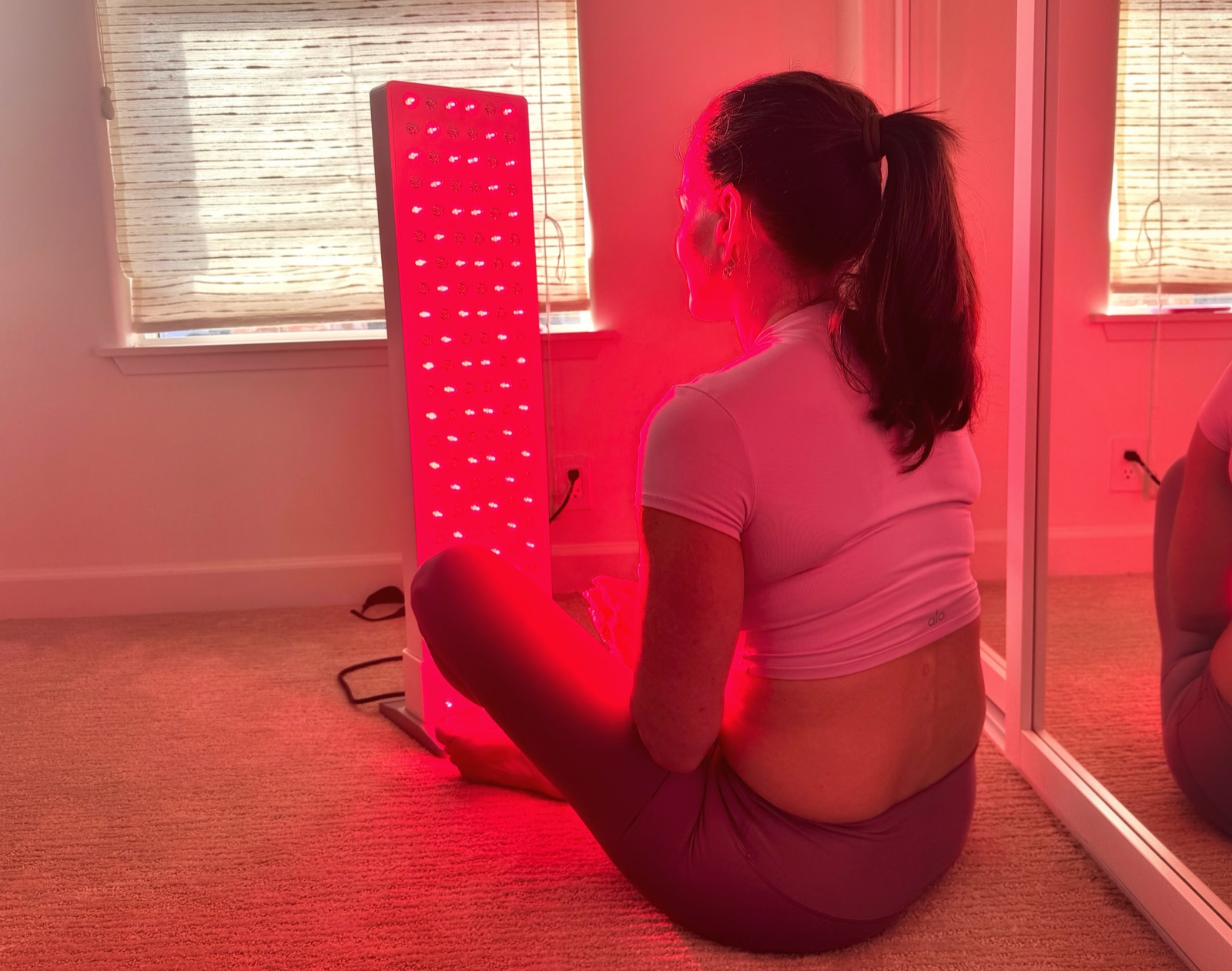
I'm a huge fan of red light therapy and have built it into my daily wellness practice. Almost every morning I sit in front of my Joovv red light panel at home for about 20 minutes. I also use a single-bulb fixture regularly for more targeted sessions. When I have an injury I want to heal as quickly and thoroughly as possible, I go in for Healios Laser Therapy. I've had wonderful results, especially with the Joovv panel and the Healios laser — I can actually feel the healing and the reorganizing happening inside my body.
The benefits I experience with the Joovv panel are a noticeable lift in energy and overall vitality, less stiffness when I get up in the morning, better recovery after cycling or yoga, calmer inflammation, and a general sense that my system is supported at a cellular level. My skin also looks more even and rested, and I feel like my body is working with me rather than against me.
The benefits I perceive from the single-bulb fixture are more localized and convenient. It's easy to use on a specific area when I don't have time for a full panel session. I notice a gentle warming, reduced tightness in that spot, and a quieter kind of support — good for maintenance between fuller treatments.
The benefits and sensations I feel from Healios Laser Therapy are deeper and more targeted. Sessions last about 25 minutes. I feel distinct, penetrating heat from the laser that goes well beyond the surface — a warming, almost organizing sensation deep inside my joints and tissues. After treatment, inflammation settles, mobility improves, and injuries recover faster and more completely than they would on their own. I also notice improvements in skin health and an overall sense that the tissue is being repaired from the inside out. It's the treatment I trust when I need real, thorough healing.
FAQs
How long until I actually see results from red light therapy?
It depends on what you're treating. Sore muscles? You might feel a difference in your first 1–3 sessions. Joint pain usually takes 4–8 weeks to really show up. Skin firmness is the slow burn — expect 8–12+ weeks. And if you're dealing with a deeper chronic issue, plan on sticking with it for 6–12 weeks before you notice real change.
Is red light therapy safe to use at home?
Yes. Unlike UV light, red and near-infrared light won't damage your DNA or burn your skin at normal doses. Home devices are also weaker than clinical lasers, so you've got a built-in safety margin. The one thing worth doing: wear eye protection, especially with a stronger panel.
Bulb vs. LED panel vs. Class IV laser — what's actually different?
Think of it as a spectrum. A single bulb is your budget, targeted option—good for a small area like your face or one joint. LED panels (Joovv being the popular example) cover more ground and hit harder, making them the go-to for home use. Class IV lasers are the clinic-only heavy hitters. They reach several centimeters deeper, which is what you need for acute injuries or serious structural issues.
How often should I actually be doing this?
3–5 times a week is the sweet spot for most goals. If you're recovering from something acute, daily sessions can help. But don't stress about hitting it perfectly. Showing up consistently matters way more than nailing a rigid schedule or going all-out every time.
Is this legit, or just another wellness trend?
It's legit. There's real clinical research—published in dermatology and pain-management journals—backing benefits for inflammation, healing, muscle and joint pain, and skin health. The science behind it centers on your mitochondria: red and near-infrared light stimulates an enzyme called cytochrome c oxidase, and that pathway is one of the better-supported mechanisms in this field of research.
Should I just buy a device, or go to a clinic?
Depends on what you're solving for. A home device is great for staying on top of things—general maintenance, mild inflammation, everyday consistency—without spending a fortune. A clinic with Class IV lasers makes more sense for something acute, a deep joint issue, or serious chronic pain that needs a stronger, supervised dose. Plenty of people do both: knock out the initial problem at a clinic, then keep a home device around to maintain the progress.